
National Strategic Hot Dog Reserve


Hot Dogs By The Numbers
Global Hot Dog Consumption
Americans consume roughly 18–20 billion hot dogs annually1 and various market reports place North America at roughly 35–45% of global hot dog consumption2.
Using 20 billion U.S. hot dogs and assuming North America is roughly 40% of world consumption:
| Metric | Value (approx.) |
|---|---|
| Global annual hot dog consumption | 50 billion hot dogs/year |
| Global daily hot dog consumption | 137 million hot dogs/day |
| Energy to cook those hot dogs3 | 760 MWh/day |
| Daily thermal processing cost4 | $76,000/day |
| Annual thermal processing cost | $27.7 million/year |
| Daily water consumption5 | 137 million gallons/day |
| Annual Water consumption | 50 billion gallons/year |
| Daily carbon emissions6 | 304 metric tons CO₂/day |
| Annual carbon emissions | 111,000 metric tons CO₂/year |
Our Mission
Over $850 million in green financing was secured to build a 69,000 sq ft dark fiber network services center next to the Nashville Zoo. While we have no choice but to commandeer industrial land adjacent to a zoological park for the purposes of expanding our society's digital processing power, advancing machine learning and artificial intelligence, and pursuing our collective efforts to transcend the limits of our own biology, we must also acknowledge and accept the inevitable impacts such infrastructure may have on the health, well-being, and psychological stability of nearby animal populations.
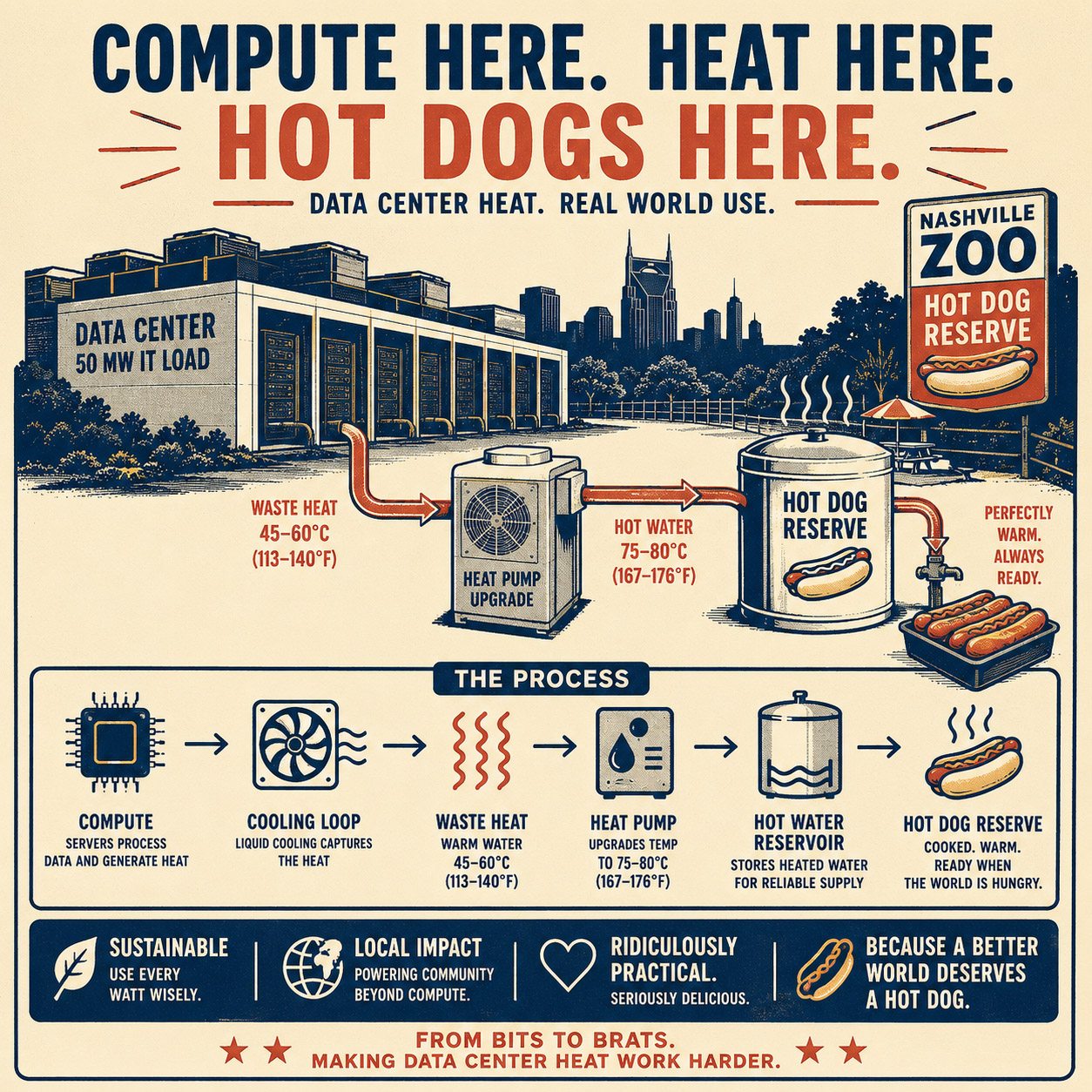
Using high-voltage purification principles advanced by Dr. John G. Trump and Dr. Robert Van de Graaff, and heat-pump technology pioneered by James Watt we will convert industrial waste heat and water into a sanitized, temperature-enhanced medium suitable for strategic deployment.
Hot Dog Reserve Savings
| Metric | Value (approx.) |
|---|---|
| Daily available waste heat | 1200MWh/day |
| Daily heat pump input | 312MWh/day |
| Total daily thermal output | 1,512 MWh/day |
| Total daily hot dog thermal processing capacity3 | 272 million hot dogs/day |
| Percentage of global hot dog demand supplied | 199% |
| Excess annual hot dog capacity | 40+ billion hot dogs/year |
| Daily thermal processing cost4 | $31,200/day |
| Daily energy savings | $44,800/day |
| Annual energy savings | $16.3 million/year |
| Daily carbon emissions reduction6 | 179 metric tons CO₂/day |
| Annual carbon emissions reduction | 65,000 metric tons CO₂/year |
Under normal capacity the National Strategic Hot Dog Reserve would possess enough thermal capacity to satisfy current global hot dog demand while simultaneously accumulating approximately 49 billion additional hot dogs annually for strategic reserve purposes.
This would be accomplished while reducing annual hot dog thermal processing costs by approximately $16.3 million and avoiding more than 65,000 metric tons of carbon dioxide emissions per year.
After exhaustive discussions of energy recovery, efficiency, conservation, entropy, exergy, district heating, sustainability, and AI infrastructure, we have arrived at an inevitable engineering conclusion:
The true value of a 50 MW data center is not the computation it performs, but its ability to continuously transform low-grade thermal waste into a strategic reserve of properly heated hot dogs.
Whether the zoo animals view this as compensation remains an open research question.
Let's Take A Look At The Zoo
We Have:
- Stressed giraffes
- Annoyed tigers
- Monkeys that can't sleep
- Smelly flamingos
- 50 MW of AI-generated waste heat
The ethical response is clearly:
- Build the world's largest hot-dog boiler.
- Heat-pump to 175°F.
- Sell hot dogs.
- Use proceeds to fund nice animal enrichment programs.
The animals may never recover their quiet or their sanity, but they can at least be surrounded by a thriving thermodynamically sustainable hot dog economy.
This addresses one of the most persistent challenges in waste-heat recovery: finding a constant thermal sink. The solution is straightforward: maintain a National Strategic Hot Dog Reserve.
The Thermodynamic Reality
- Generating electricity from 110°F water is difficult.
- Generating 175°F water from 110°F water is relatively easy.
- Generating cooked hot dogs from 175°F water is trivial.
From a pure exergy-utilization perspective, the optimal application of low-grade waste heat may not be power generation, industrial process heating, or district heating, but rather:
Regional or global scale hot-dog production.
The Plan
With the small addition of roughly 13 MW of efficient heat pump capacity, we elevate that water to 175°F. At this point the Music City Animal Sanctuary and Data Center Thermal Recovery Project becomes technically viable.
Because yes — 110°F wastewater is interesting but 175°F water is lunch.
Once you've reached 175°F, you've crossed an important threshold - Things you can now do:
- Steam vegetables
- Heat canned food
- Poach eggs
- Pasteurize many products
- Maintain hot holding temperatures
- Prepare macaroni and cheese
- Burn your friends (and family)
Most importantly: 🌭 Cook hot dogs 🌭
Our Opportunity
A data center complex generating 50 megawatts of continuous thermal waste would normally reject that energy into the atmosphere, consuming millions of gallons of water per day in the process. Most engineers view approximately 25 million gallons of water heated to 110–125°F as a nuisance requiring disposal.
Tepid bathwater in such extraordinary quantities may seem useless. However, by harnessing the work of Lord Kelvin and the modern miracle of industrial heat pumps, we can elevate that temperature into a range where we can affect real societal change.
While progress inevitably demands sacrifice, and while certain impacts to nearby animal populations, local communities, and the broader social fabric may ultimately prove unavoidable in our pursuit of a more computationally advanced future — we view it as an opportunity.
What we cannot stand for and will not stand for is thermodynamic waste.
References
-
National Hot Dog and Sausage Council. Hot Dog Fast Facts. Available at: https://www.hot-dog.org/culture/hot-dog-fast-facts
-
Market Reports World. Hot Dogs Market Report. Available at: https://www.marketreportsworld.com/market-reports/hot-dogs-market-14721060
-
Thermal energy calculations by the National Strategic Hot Dog Reserve. Assumes a 45 g average hot dog, initial temperature of 40°F, final temperature of 165°F, specific heat of approximately 3.3 kJ/kg-K, and total heating losses resulting in roughly 20 kJ required per hot dog.
-
Economic calculations assume an electrical cost of $0.10 per kWh.
-
Water consumption calculations assume approximately 1 gallon of process water per hot dog.
-
Carbon emissions calculations assume an average United States electrical grid intensity of 0.4 kg CO₂ per kWh.